Jacob Ramos
I build the apps that run your business — from custom e-commerce platforms to geospatial tools to AI agents that work while you sleep.
SPSkywayMap
As a St. Paul resident, I wanted to give back to my community in a way that could have real impact. The skyway system connects 47 blocks of downtown but had no usable digital map — so I built one.
A geospatial navigation app mapping all 47 blocks of Saint Paul's skyway system. Multi-layer indoor maps with time-based routing, business POI search, transit integration, and ADA accessibility data — built on PostGIS with custom OpenStreetMap tiles. Businesses claim their listing through an onboarding call, then run hours, photos, events and review responses from a self-serve dashboard with one-way Google Business Profile hours sync.
SkywayRoutingStack
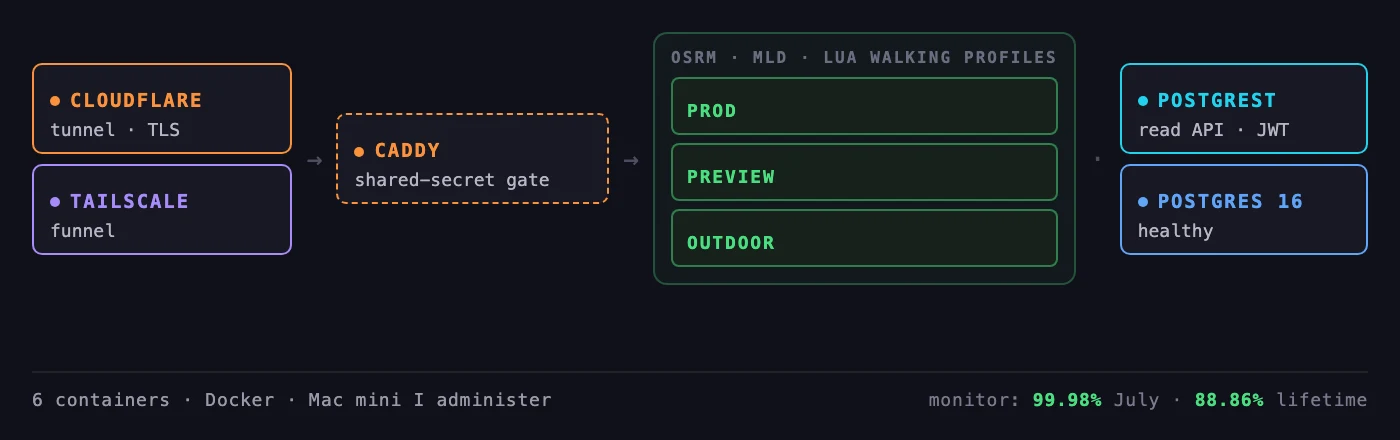
Turn-by-turn routing through the skyway needs a graph engine, and the hosted options either could not express an indoor network or wanted per-request money for a civic map with no revenue. So the routing runs on a Mac mini in my apartment — which means I own the uptime, and had to learn what that actually costs.
The routing backend for spskyway.com: three OSRM engines in Docker — production, a preview lane for graph promotes, and an unbiased outdoor profile — behind Caddy, with hand-written Lua profiles that bias walking routes onto the named skyway network. Ingress is a Cloudflare tunnel and a Tailscale funnel; a shared-secret header gates everything but the version endpoints; Postgres and PostgREST sit alongside. A cron script probes four endpoints every five minutes and mails me when one stops answering.
CityPortal
The city can't act on foot-traffic vibes. After the public map, I built the evidence layer: a sensor network over downtown and an authenticated portal where city staff see what's actually moving — with the privacy posture engineered in, not promised.
An authenticated common operating picture for City of Saint Paul staff. Live skyway foot traffic from Raspberry Pi sensors with on-camera AI person detection, joined with NWS weather and EPA air quality. Dashboard data reaches the city's browser only through a hand-enumerated field allowlist, and the live crossing feed is stripped server-side to bare count ticks. Counts display as calibrated ranges set against a manual head count, and every number carries a plain-language note explaining how it's made. The whole view lives in the URL — except the live-camera switch, deliberately excluded so a shared link can never start a stream.
FriendsOfSkyway
Friends of the Saint Paul Skyway is a grassroots group working to preserve and expand downtown's skyway system. They needed more than a brochure — a working platform to run events, register members, gather community input, and broadcast updates. So I built one.
The organizing platform for Friends of the Saint Paul Skyway. A Next.js front-end paired with a 14-table Supabase schema powers event registration with guests and waitlisting, member signups, surveys, a community document library, QR short-link tracking, and a role-gated admin dashboard for running check-ins, exporting CSVs, and sending Resend email campaigns.
SkywayEat
Friends of the Skyway runs a seasonal dine-around event across multiple downtown restaurants. Attendees needed to rate dishes in real time, chefs needed a menu and sold-out console, and everyone needed a personalized recap email afterward. A single app had to hold all three audiences without confusing any of them.
A full-stack event platform with three distinct auth flows — attendee, chef, and admin — sharing a Supabase schema. Attendees scan in with zero taps, hold a 30-minute slot with a push warning near its end, and get pointed at whichever room has headroom next. Chefs manage menus and sold-out state. Admins watch a live health dashboard. Server actions compute a Bayesian-ranked 'Dish of the Night' and Resend dispatches HTML recap emails when the event closes.
MetroTransitLive
The skyway map needed transit integration, and I was not going to wire a feed I did not understand into a product people navigate with. So before touching the map, I built an instrument to watch Metro Transit's NexTrip GTFS-RT feed misbehave — every vehicle in the Twin Cities, live, until its quirks were obvious.
A developer instrument, not a consumer app. It decodes the GTFS-RT protobuf feed, snaps every vehicle to official route polylines from MnDOT shapefiles, and dead-reckons along real road geometry between 10-second polls — so the raw feed's teleporting coordinates become watchable motion. Running it is how I learned the feed's lag, its off-route vehicles, and its poll cadence before integrating transit into spskyway.com. Desktop-only on purpose: its user was me.
ForeverYoungThrift
Forever Young is a vintage and thrift shop in downtown Saint Paul run by two brothers, Isaac Garcia and Jose Garcia Jr. Every piece is one of a kind, which breaks the assumption sitting under most store software: that a listing can sell more than once. The register and the website can both reach for the same jacket, and exactly one of them is allowed to win.
A storefront and back office built around a single unit that can only sell once. The cart clamps every line to one, checkout re-fetches price and sold status on the server instead of trusting the browser, and the Square register and the website tell each other the moment something sells. The admin is built for a phone held over a rack: an in-app camera, HEIC conversion and downscaling before upload, on-device barcode scanning that prefills name and brand, and a button that opens eBay sold listings so pricing comes from real comps rather than a guess. Pickup orders move through three columns with an email at each step. Analytics read only the database, so a failed sync shows up as an error instead of as zero dollars.
DowntownStPaul
Downtown Saint Paul gets described in press releases and in complaints, and the two do not agree. I wanted a resident-run guide where no number appears without the period it covers and a link to where it came from, including the numbers that make downtown look bad.
An independent guide to downtown Saint Paul. The scoreboard prints five headline figures, each stamped with its as-of date and linked to its source, and a unit test fails the build if either is missing. Where the official numbers disagree the page shows the range and names the disagreement rather than picking a side: office vacancy is published as roughly 12% to 40% depending on the firm and on what counts as inventory. A board at /now works out which downtown places are open at the current Central time from OSM opening-hours strings, carries a rail of what opened or closed in the last 30 days written by a nightly job that diffs the database against its own previous run, and accepts resident event submissions that stay invisible until a moderator approves them. Officeholders are stored role-first with the date each name was confirmed, on the theory that names go stale and roles do not.
LinearParkAlliance
Saint Paul's skyway is five miles of climate-controlled, publicly owned corridor that the city classifies as building circulation. The Alliance argues it should be reclassified as a linear park. That case lands better if you can walk it, so the site is one horizontal walk rather than a stack of pages. I founded the Alliance and wrote the site.
A single horizontally scrolling walk through 21 panels. Mouse wheel, arrow keys, Home/End and a bottom rail of building silhouettes all drive the same track, which glides and then snaps to the nearest panel about a third of a second after you stop, while a counter climbs from mi 0.0 to 5.0 to map your position on the page to the length of the real corridor. Seven precedent panels cover the High Line, the San Antonio River Walk, Seoul's Cheonggyecheon, the Tampa Riverwalk, the Indianapolis Artsgarden, the Des Moines Skywalk and Saint Paul's own Town Square Park, each pairing photography with a video that does not start downloading until you press play. Under 1024px the same panels stack and scroll vertically, so there is no separate mobile build. One reading on the page is live: downtown air quality and temperature from Open-Meteo, refreshed every ten minutes and coloured by EPA category.
DazzlingDoggieDuvet
The core challenge was explaining a patent-pending dog bed to customers — what it is and how to use it. I built the entire platform from the ground up to make the product intuitive through the shopping experience itself.
A fully custom e-commerce platform with a 42-table Supabase schema, Stripe-powered checkout, loyalty points engine, UGC community with photo reviews, and an AI agent (Cleo) running on a Mac Mini that handles customer service, inventory, and marketing autonomously.
DowntownRevivalTrust
A property trust buying and restoring historic buildings in downtown Saint Paul needed a public face that reads like an institution rather than a startup — and a structure that could hold a growing portfolio without a redesign each time a building is added.
An editorial site for a historic real-estate trust: numbered sections for mission, properties, investments and partners, set in a serif type system with drop caps and rules that borrow from print rather than from software. Built to take on new buildings as sibling pages under one identity.
GreatNorthernBuilding
A 1910 Lowertown office building was being marketed on a site that undersold it. I built the redesign as a working site rather than a deck — the argument for the rebrand is easier to make when you can click it.
A leasing site for the Great Northern Building, designed as part of the Downtown Revival Trust family: full-bleed black-and-white architectural photography, a fact sheet of floor plates and availability, neighbourhood context, and amenities — all under the Trust's identity so the portfolio reads as one owner.
TaskForceContractors
Task Force Contractors is a Service-Disabled Veteran-Owned small business in Tampa doing custom builds and remodels. They needed more than a brochure site — a working CRM so one operator could run leads, convert them to clients, and send branded email campaigns without paying a SaaS tax on top of their construction work.
A full-stack Next.js site with a built-in admin CRM. The public side shows off 19 before/after galleries, 7 service categories, testimonials, team bios, a Leaflet service-area map, and a lead-capture form. The admin side runs a 5-stage Kanban pipeline (New → Contacted → Proposal → In Progress → Completed), converts inquiries to clients, and sends bulk email campaigns with dynamic name substitution from a 5-template library.
SkywayIOS
The web map answers 'where is it' at a desk. Walking the skyway is a different problem: you are indoors with no street to orient by, GPS gets unreliable between floors, and you want the phone in your pocket rather than in your hand. That needs a native app that can keep talking while it is locked.
A SwiftUI iPhone client for the skyway. It plans a route between two places and then speaks the turns with the phone locked and pocketed, ducking music instead of stopping it, while a Live Activity on the lock screen and Dynamic Island carries the next maneuver, the distance to it and the level you are on. Kill the app mid-walk and relaunching offers to resume at the step you were on. Indoors it ranges iBeacons and fuses them with GPS along the route, with RSSI smoothing, path-loss distance, a two-beacon crossfade and an along-route Kalman filter; that fusion path is exercised by a synthetic sighting generator in tests, not yet by hardware in the field. The explore map carries paths, buildings, entrances, parking and transit with a level selector and four basemap styles, and an entrance scout built on Look Around drops you at a specific door.
Ramosware
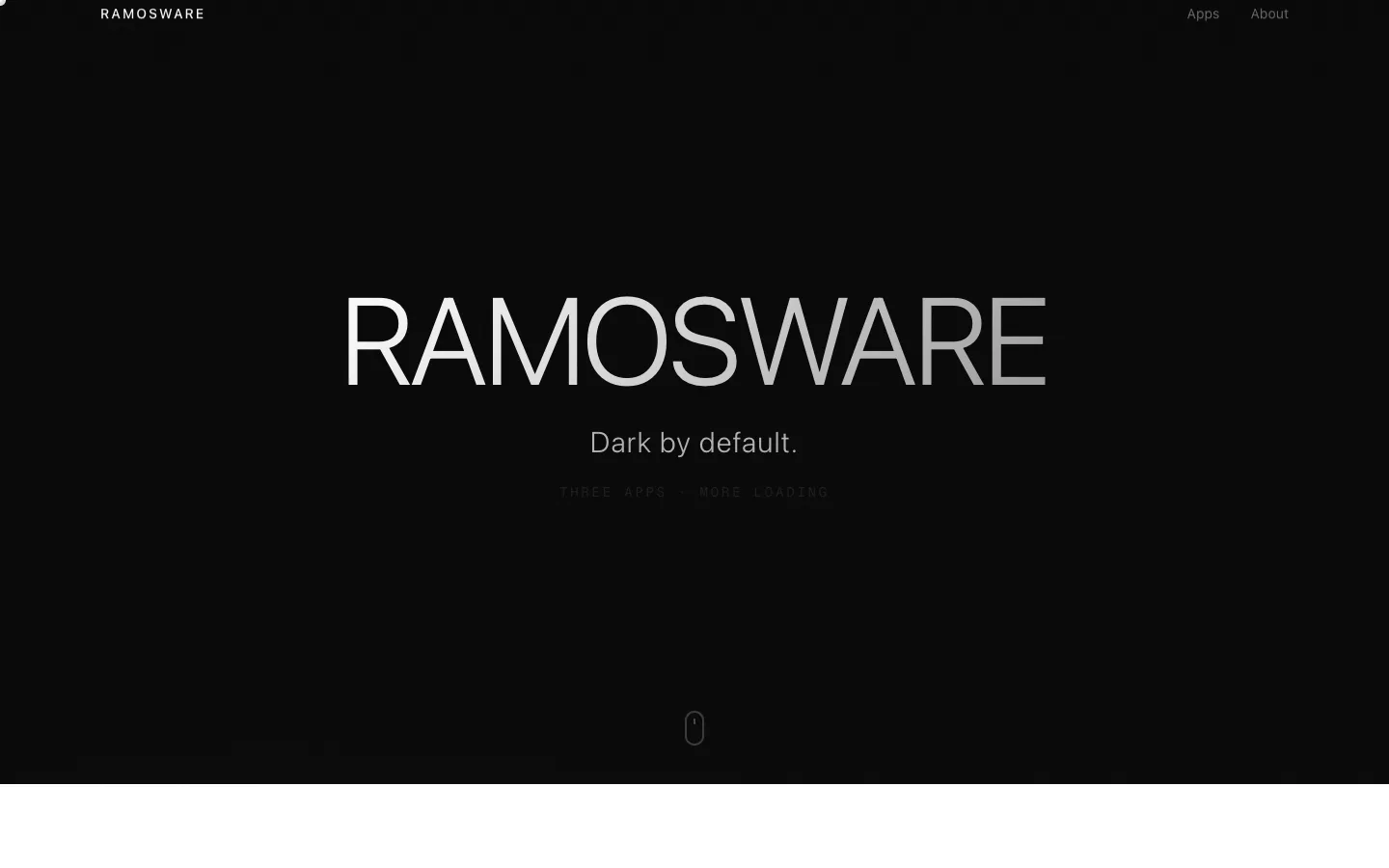
I needed a home for my indie app studio — somewhere that matched the dark-first philosophy of the apps themselves. Not a template, not a Squarespace site. Something built from scratch that feels like the products it represents.
The marketing site for RAMOSWARE, a dark-first indie app studio shipping iOS and visionOS apps. Features a Three.js 3D wireframe hero, Framer Motion scroll-linked animations, glassmorphism app cards with perspective tilt, custom cursor, and grain overlays — all optimized for performance without sacrificing visual polish.
What I Build
Every project is built from scratch to fit the problem. No templates, no page builders — just clean, production-ready code.
Full-stack applications built with Next.js, React, and TypeScript. From concept to deployment on Vercel — designed around your specific business needs.
Custom storefronts with Stripe checkout, subscription billing, loyalty systems, and admin dashboards. Not templates — built from the ground up for your product.
Interactive maps and location-based tools built on PostGIS, Leaflet, and OpenStreetMap. Indoor navigation, spatial queries, and custom tile layers.
Autonomous AI agents that handle real business operations — customer service, inventory management, email marketing, and more. Running 24/7 on your infrastructure.
How I Work
Every project follows a clear, predictable process from first conversation to production deployment.
We talk about your idea, your goals, and what success looks like. No jargon, no pressure — just a conversation about what you need built.
You get a clear plan with specific deliverables, timeline, and investment. No surprises down the road.
I develop in sprints and share progress along the way. You see real, working software — not mockups — throughout the process.
I handle deployment, DNS, and production setup. After launch, I stick around to make sure everything runs smoothly.
About
Eleven years building for the web — sites and email programs alongside every job I've had: political campaigns, client work, car sales. Page builders then; since November 2025 I write and commit the code myself, and that turned into Open-CIV — five products live in production, with a focus on geospatial data, e-commerce, and AI agent systems.
Start a Project
Have an idea for a web app, e-commerce platform, or something that doesn't exist yet? Tell me about it.